Blog
Written by

Naman Mathur
Published on

Every month-end close, finance teams face the same grind. A number moved. The CFO wants to know why. And so begins the detective work: exporting data from NetSuite, cross-referencing transactions in Excel, writing a narrative that may or may not hold up under scrutiny.
It shouldn't take three days to answer one question.
The Hidden Cost of Variance Analysis
Flux analysis, comparing what changed, why it changed, and whether it makes sense, is one of the most critical activities during month-end close. It's also one of the most manual.
Accountants spend 1–3 days per entity on this process alone. The workflow looks something like: export data from the ERP, review transaction lines, search for the invoice driving the variance, write a narrative, share with management, and repeat next month.
Most of that time isn't spent thinking. It's spent searching. As one accountant put it during user research:
"The time taken to find out which invoice is driving it… that could be time better spent."
A few things make this worse than it sounds:
Every report starts from scratch in a spreadsheet. Linking a variance back to its root transaction means jumping between systems. Misposted entries go unnoticed until the last day of close. And even when explanations get written, they tend to describe the what without ever getting to the why, leaving management with numbers but no real insight.
The Balance No One Has Cracked Yet
Most close management tools help teams organize the process: checklists, task assignments, and status tracking. But they stop short of the analysis itself. They can surface that a variance exists. They can't explain why with any confidence.
The core problem is structural. Deterministic systems can't reason. AI systems that can reason tend to hallucinate. Finance teams need both: the rigor of hard rules grounded in ERP data, and the reasoning ability to synthesise that data into a narrative someone can actually defend in a board meeting.
Meet Flux AI Agent, Your AI Analyst
Flux AI isn't a report generator. It's an agent that investigates variances the way a senior analyst would, except it takes 20 seconds instead of 20 hours.
The core idea: the AI can reason and explain, but it cannot fabricate. Every number, every transaction, every insight is sourced directly from your ERP through deterministic queries. Agentic adaptability with deterministic accuracy underneath.
How It Works
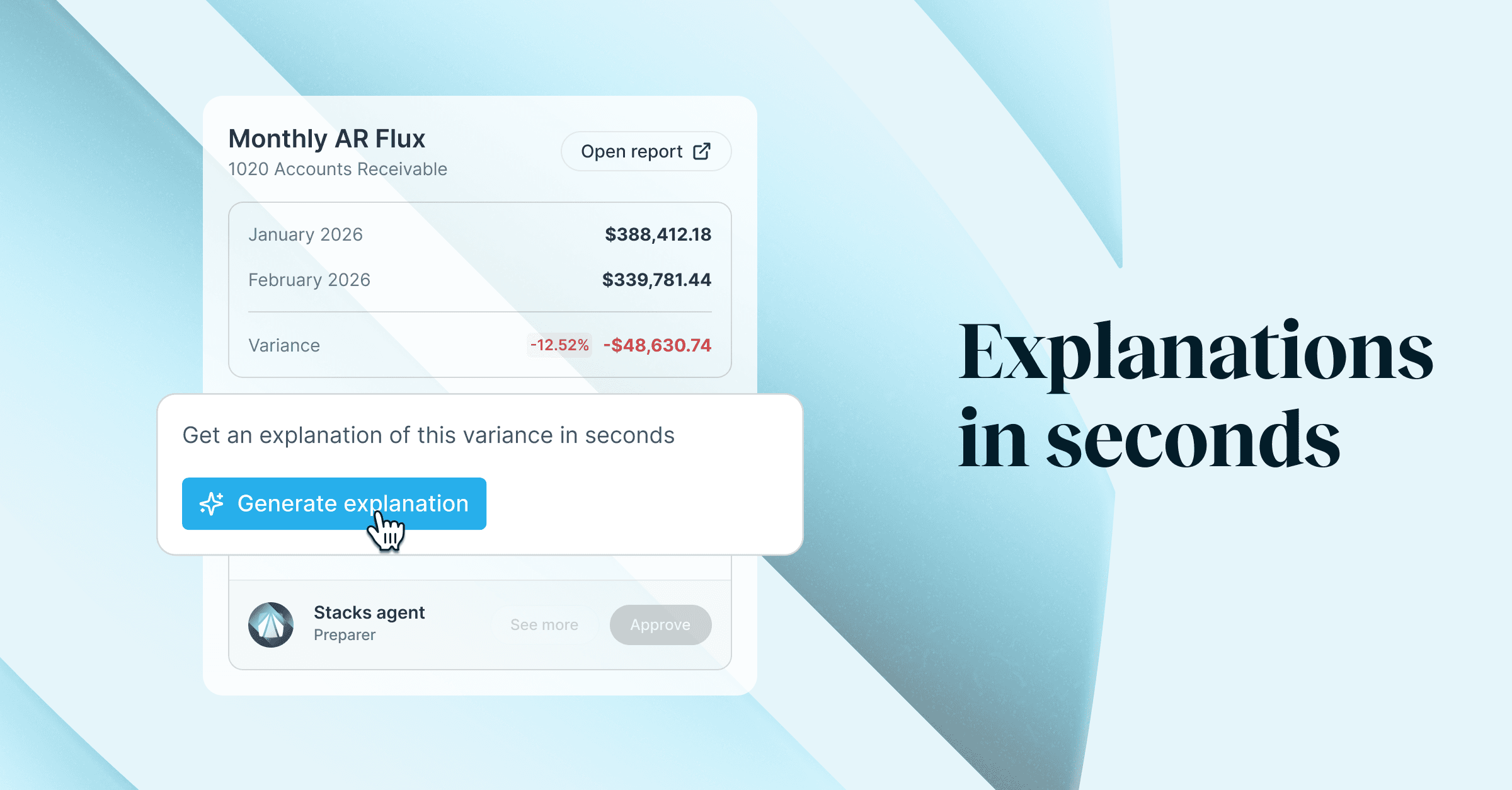
Identify the variance. The system receives an account (e.g., "Software Subscriptions"), two time periods (e.g., January vs. February), and the delta (e.g., $45,000 to $62,000). That's the starting signal.
Gather evidence. Rather than reading a static export, the agent runs multiple analyses in parallel: a statistical summary across both periods, the largest debits and credits with full transaction context, a dimensional breakdown by department, location, customer, or vendor, and 12 months of historical variance trends to separate seasonal patterns from genuine anomalies.
Enrich the context. Each transaction gets layered with date, description, type, customer or vendor name, department, location, and double-entry context showing which other accounts were affected in the same transaction. Statistical outliers are flagged using z-scores. This is the layer most tools skip entirely. It's also what separates a surface-level explanation from an audit-grade one.
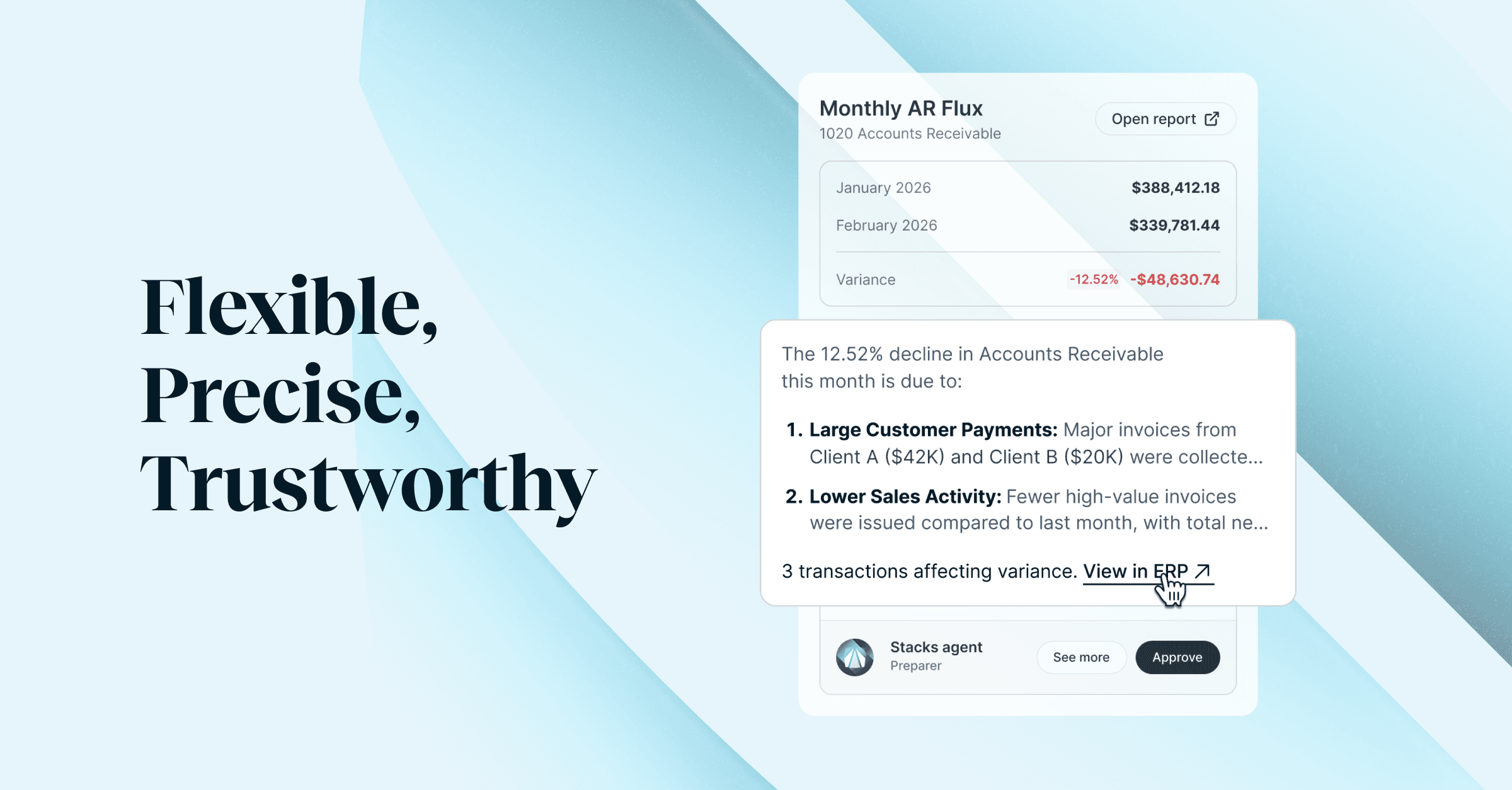
Generate the explanation. All that evidence goes to a large language model with specific instructions: compare current vs. prior period patterns, identify primary drivers, quantify findings with specific amounts and percentages, write in CFO-ready language. The output isn't a generic summary. It references specific transaction IDs, calls out anomalies, and contextualizes the variance against historical trends.
Output. A concise, factual explanation with citations to the most impactful transaction lines, quantified insights, and full auditability back to source data.
What Teams Actually Asked For
Conversations with our customers kept surfacing the same requests.
Flexibility matters more than features. Teams want to set their own dimensions, departments, locations, vendors, cost centres, and configure materiality thresholds by amount, percentage, or both. Analysis has to happen at the level of business drivers, not just GL account codes.
Drill-down was the thing that made people lean forward. Clicking from a variance directly to the underlying transactions and from there into NetSuite collapsed hours of investigation into seconds.
"This is fantastic… seeing the transactions that drive it in context with the explanation."
AI explanations have to be trustworthy to be useful. That means specific transaction references, proper accounting language (not cash-style wording), and enough granular detail, vendor, department, region, product, that an auditor could follow the logic. Users also want to edit explanations without losing the ability to regenerate them.
The report-level summary was an unexpected hit. A single narrative covering all material variances, written in board-ready language. Teams said this was something they desperately needed but never had time to produce.
"It's one of those things that we don't have time to do today. It would be nice if we could do it, and it would have a big impact if we did."
The Direction This Is Heading
Variance analysis has always been treated as a necessary cost of the close: slow, error-prone, and chronically under-resourced. The path forward is pretty clear. Move from manual reporting, to automated reporting, to something closer to a true analysis partner. An agent that investigates, explains, and gets better over time. One where finance teams spend their energy reviewing and refining, not searching and summarizing.
That's what Flux AI is building toward. And given that the detective work currently eats 1–3 days every single close, the upside of getting this right is enormous.